

Best Incontinence Diapers for Overnight: Top Picks
Table of Contents
- Quick Comparison: Best Incontinence Diapers for Overnight
- How to Choose High Absorbency Adult Diapers for Nighttime
- Overnight Diaper Sizing Guide: Getting the Fit Right
- How to Prevent Leaks With Adult Diapers at Night
- Cost per Unit and Insurance Options for Overnight Protection
- Dignity, Discreetness, and Mobility: What Competitors Skip
- Conclusion: Matching the Right Overnight Diaper to Your Needs
- Frequently Asked Questions
Last Updated: September 10, 2026
Quick Comparison: Best Incontinence Diapers for Overnight
The best incontinence diapers for overnight use combine a high-capacity polymer core, barrier cuffs, and a waistband that stays put through eight to twelve hours of sleep. According to the National Association for Continence, bladder leaks affect millions of adults, and nighttime control is one of the most common reasons people seek high absorbency adult diapers. This guide from Bumz, Inc breaks down capacity, fit, cost, and the features that actually prevent leaks, so you can choose overnight protection that holds up until morning.
Quick Picks:
- Best Overall: Bumz Maximum Absorbency Tape-On Briefs, 11,000mL capacity, wetness indicator, odor-reducing core
- Best for Heavy Output: Bumz Extra Large (46"-60") case, maximum absorbency for larger body types
- Best Way to Test Fit: Bumz 2-count sample packs, try sizing before committing to a full case
Option |
Size Range |
Capacity |
Count |
Price |
|---|---|---|---|---|
Bumz Maximum Absorbency Small |
22"-34" |
11,000mL |
40 |
$133.99 |
Bumz Maximum Absorbency Medium |
28"-38" |
11,000mL |
40 |
$137.99 |
36"-48" |
11,000mL |
40 |
$141.99 |
|
Bumz Maximum Absorbency Extra Large |
46"-60" |
11,000mL |
40 |
$144.99 |
How to Choose High Absorbency Adult Diapers for Nighttime
Choosing high absorbency adult diapers for nighttime comes down to three things: how much fluid the core holds, how fast it wicks, and whether the fit seals against leaks. A diaper rated for daytime use will not hold up across a full night, so look for products built specifically for extended wear.

Capacity, Core Technology, and Wetness Indicators
Capacity is measured in milliliters, and overnight products typically start well above daytime briefs. Bumz briefs carry an 11,000mL capacity rating with an advanced filler that absorbs quickly to help prevent leaks. A wetness indicator that shifts from yellow to blue tells you when a change is needed without guesswork. The polymer core locks moisture away from skin, which matters for skin integrity during long wear.
Tabbed Briefs vs. Pull-Ups for Overnight Use
Tabbed briefs win for overnight use in most cases. Re-fastenable tapes let you adjust the fit after the diaper is on, and you can change a brief without fully undressing, which helps caregivers and anyone with limited mobility. Pull-ups suit people who can stand and step into them independently, but they offer less adjustability and generally less capacity. For heavy output or overnight capacity, a tape-on brief is the more reliable choice.
Overnight Diaper Sizing Guide: Getting the Fit Right
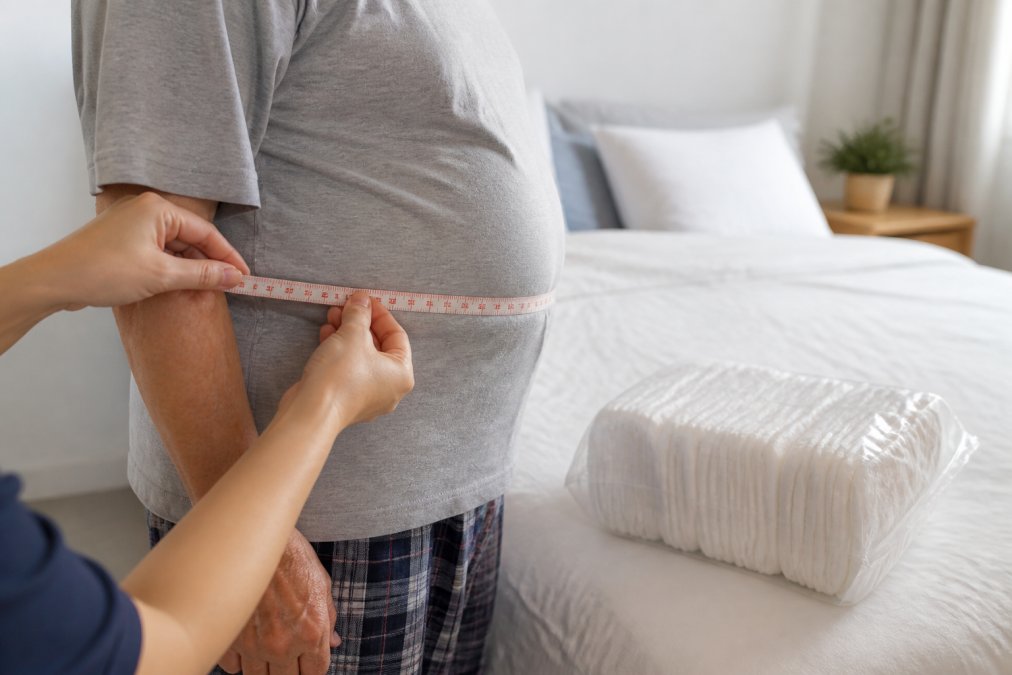
Sizing is where most overnight leaks start, and it is the step most buyers rush. A brief that is too large gaps at the legs and waist; one that is too small cannot contain a full night's output and will wick at the edges. Getting this right takes two measurements, not one.
Measure Waist and Hips, Not Just One Number
Use a soft measuring tape and measure at two points:
- Waist: at its widest point, usually just above the navel.
- Hips: at the fullest part of the seat, typically 7 to 9 inches below the waist.
Match the larger of the two numbers to the product's stated range. Most manufacturers publish a waist range, but the hip measurement is what actually determines whether the leg openings seal. If your waist and hips fall into different sizes, size to the hips for overnight use, a slightly loose waist can be tightened with tapes, but leg gaps cannot be closed after the fact.
Size Ranges and When to Size Up
Bumz offers four sizes: Small (22"-34"), Medium (28"-38"), Large (36"-48"), and Extra Large (46"-60"). Note that the ranges overlap by design, a 36-inch waist can wear either Medium or Large depending on hip measurement, body shape, and output volume.
Size up when any of these apply:
- Your hip measurement sits at the top of a range.
- You sleep on your side (side-sleepers need more material across the hip and back).
- You have heavy overnight output or use the brief for 10 to 12 hours.
- You have a larger midsection relative to your hips, a common pattern where waist-only sizing fails.
Size down only if the brief is visibly loose at the legs after fastening and the cuffs will not stay upright.
Fit Checks Before You Trust a Brief Overnight
Before relying on a new size for a full night, run these checks after fastening:
- Two-finger test at the waist. You should be able to slide two fingers flat under the waistband. Tighter than that compresses the core; looser and the brief will shift.
- Cuff check. Run a finger along each leg opening. Barrier cuffs must point outward, away from the body. A folded-in cuff creates a channel for fluid to escape.
- Rise check. The front panel should reach roughly to the navel and the back panel should cover the tailbone. If the back sits low, side-sleepers will leak at the hip.
- Tape landing zone. Tapes should land on the reinforced front panel, not on the side panels, and should be pressed firmly, not stretched, to seal.
Body Shape Matters as Much as the Number
A person with a larger midsection may need a different size than their waist measurement alone suggests, because the brief has to wrap around the abdomen rather than sit at the waist. Similarly, someone with narrow hips and a larger waist may find that a size that fits the waist gaps at the legs. This is why sample packs exist: they let you test two adjacent sizes against your actual body before committing to a case.
How to Prevent Leaks With Adult Diapers at Night
Leaks overnight usually trace back to positioning, not product failure. Getting the brief centered and the cuffs standing upright prevents most of them.
Positioning, Barrier Cuffs, and Skin Integrity
Lay the brief flat, center the core under the body, and pull the front up evenly before fastening the tapes on the landing zone. Run a finger along each leg opening to make sure the barrier cuffs point outward, not folded inward. A folded cuff creates a channel for fluid to escape.
Skin integrity depends on keeping moisture off the skin. A moisture-wicking core and a breathable backing reduce the risk of skin breakdown during extended wear. Change the brief as soon as the wetness indicator signals, and clean and dry the skin fully between changes.
Cost per Unit and Insurance Options for Overnight Protection
Cost per unit, not case price, is the number that matters for a monthly budget. But the more useful number for overnight use is cost per night, because a cheaper brief that leaks and forces a mid-night change costs more in laundry, skin care, and sleep than a higher-capacity brief that holds until morning.
Cost per Unit vs. Cost per Night
A 40-count case of Bumz briefs runs $133.99 to $144.99 depending on size, which works out to roughly $3.35 to $3.62 per diaper. A 10-count pack runs $33.99 to $36.99, useful for testing before buying in bulk. If you use one brief per night, that is your cost per night. If a lower-capacity product requires a change at 2 a.m., you are paying for two briefs plus disrupted sleep, which is why overnight capacity ratings matter more than sticker price.
Subscription and bulk ordering reduce the per-unit cost over time. Bumz keeps no markup on shipping and handling, with distribution relocating to the Midwest to shorten transit times, which matters if you order monthly and want predictable delivery.
FSA and HSA Eligibility
Bumz products are FSA/HSA eligible, so you can pay with pre-tax funds if you have a flexible spending or health savings account. Check your plan's rules on which incontinence supplies qualify, since coverage varies. In general, incontinence briefs and underpads are treated as qualified medical expenses when used to treat a diagnosed condition, but plans differ on documentation and whether a letter of medical necessity is required (irs.gov). Keep receipts and, if your plan asks, a note from your clinician describing the condition.
Medicare and Medicaid: What Actually Gets Covered
This is the part most buying guides skip, and it is where the real money is. Original Medicare (Part B) generally does not cover disposable incontinence briefs for use at home (medicare.gov). Coverage is typically limited to supplies used during a covered stay in a skilled nursing facility or, in some cases, as part of home health care under a plan of care. Medicaid coverage is state-by-state: some state programs cover incontinence supplies for beneficiaries who meet functional and financial criteria, often with monthly quantity limits and a required prescription.
Practical steps to navigate coverage:
- Ask your clinician for a prescription that names the product type (for example, "adult briefs, maximum absorbency, for overnight use") and the quantity per month. Even when insurance does not pay, a prescription supports FSA/HSA reimbursement and Medicaid requests.
- Contact your state Medicaid office or your plan's member services line and ask specifically: "Are disposable incontinence briefs a covered benefit for home use, and what is the monthly quantity limit?"
- Check Medicare Advantage and Medigap. Some Medicare Advantage plans add supplemental benefits that include incontinence supplies. These vary widely by plan and county.
- Use a medical supply retailer that bills insurance. Many durable medical equipment (DME) suppliers handle the paperwork and can tell you up front whether your plan covers a given product.
- Track your out-of-pocket spending. If you itemize deductions, unreimbursed medical expenses above the IRS threshold may be deductible. Keep a running log of purchases.
Comparing Cost Across Absorbency Tiers
When you compare products, normalize to cost per night at your actual usage:

- One brief per night, no leaks: divide case price by count.
- One brief plus a booster pad: add the pad cost to the brief cost.
- Two briefs per night: double the per-unit cost, this is where a higher-capacity brief usually wins on total cost.
Run that math before choosing on price alone. The cheapest per-unit brief is rarely the cheapest per night.
Dignity, Discreetness, and Mobility: What Competitors Skip
Most buying guides treat incontinence as a purely mechanical problem. It is not. Dignity, discreetness, and mobility shape which product a person will actually use consistently, and ignoring them leads to products that sit in a closet.
Overnight briefs are bulkier by design, because capacity requires material. The tradeoff is real, but it happens at night, when discreetness matters less than staying dry until morning. For people with limited mobility, tape-on briefs allow a caregiver to change the product without lifting or repositioning the person repeatedly, which protects both dignity and skin. Odor-reducing technology in the core addresses the anxiety many people feel about smell, which is often the reason someone avoids leaving the house. Choosing a product that fits well and performs reliably does more for confidence than any marketing claim.
Conclusion: Matching the Right Overnight Diaper to Your Needs
The right overnight diaper is the one that fits your body, matches your output, and holds up for the full night without leaks. Start with a sample pack to confirm sizing, then move to a case once you know the fit works. Bumz Maximum Absorbency briefs offer an 11,000mL capacity, a fast-wicking core, a wetness indicator, and odor-reducing technology across four sizes, all FSA/HSA eligible and shipped without markup on handling. Get started with Bumz, Inc and wake up dry.

Frequently Asked Questions
What diaper holds the most pee overnight?
Look for a stated capacity of at least 8,000mL. Bumz maximum absorbency briefs list 11,000mL and use a fast-wicking polymer core that locks fluid away instead of letting it pool. Capacity numbers assume a correct fit, so a brief that gaps at the legs will leak well before it reaches its limit.
What features matter most in overnight incontinence diapers?
Prioritize four things: stated capacity, barrier cuffs or high leak guards, a wetness indicator, and re-fastenable tapes so you can adjust without wasting a brief. A breathable backing and odor-neutralizing layer matter for extended wear. Skip products that only advertise 'ultra absorbent' without a number.
How do I choose the right size for overnight adult diapers?
Measure the waist at its widest point, not the pants size. Bumz sizes run small (22"-34"), medium (28"-38"), large (36"-48"), and extra large (46"-60"). If you fall between two, size up: a larger brief can be taped tighter, but an undersized one will gap and leak. Sample packs let you test before committing to a case.
Are overnight diapers FSA or HSA eligible?
Yes. Incontinence briefs are generally treated as eligible medical expenses under IRS rules for flexible spending and health savings accounts, and Bumz products are labeled FSA/HSA eligible. Keep your receipts. If you have a prescription or letter of medical necessity, some plans will reimburse more smoothly.
How can I prevent leaks with adult diapers overnight?
Point the brief's core where the flow actually happens, press the front and back panels flat against the body, and check that the barrier cuffs stand upright rather than folded inward. Tape snug but not tight, then run a finger along each leg opening. For side sleepers, add a booster pad in the front third of the brief.