

How to Stop Diaper Leaks: A Sizing & Fit Guide
Table of Contents
- Why Adult Diapers Leak Even When They Seem to Fit
- Adult Diaper Sizing Guide: Finding Your True Waist Measurement
- How to Choose the Right Absorbency Level
- Step-by-Step: Proper Fastening, Side Tabs, and Leg Cuff Positioning
- Overnight Incontinence Management: Preventing Nighttime Leaks
- Troubleshooting Leaks: Signs of Poor Fit and Quick Fixes
- Frequently Asked Questions
Last Updated: September 10, 2026
Why Adult Diapers Leak Even When They Seem to Fit
Most leaks have nothing to do with a defective product. They happen because of three fixable issues: gaps at the leg openings, compression from tight clothing, and exceeding the brief's liquid capacity. This guide from Bumz, Inc breaks down each cause so you can stop diaper leaks for good.
The frustrating truth is that a diaper can feel secure when you put it on and still fail an hour later. A common mistake is assuming a leak means you need a bigger size. Often, the opposite is true: a diaper that is too loose bunches and creates channels for urine to escape. According to the National Association for Continence consumer guidance, proper fit remains one of the most overlooked factors in leak prevention.
Common Causes of Leaks: Gaps, Compression, and Overcapacity
Gaps form when the leg cuffs are not positioned correctly or the waistband is not snug. Any opening lets liquid travel straight out.
Compression leaks happen when tight pants, waistbands, or sitting positions squeeze moisture out of a saturated core. The diaper has not failed, it has been physically wrung out.
Overcapacity is the simplest cause: the brief has absorbed all it can hold, and the next void has nowhere to go. This is why matching absorbency to your output matters more than brand loyalty.
Adult Diaper Sizing Guide: Finding Your True Waist Measurement
An adult diaper sizing guide starts with one number: your actual waist measurement, taken at the widest point. Do not guess from your pants size. Clothing sizes vary between manufacturers, and a "large" in one brand may fit like a medium in another.
Measure your waist at its fullest point, usually just above the navel. Then measure your hips at the widest part. Use the larger of the two numbers to select your size, then check the manufacturer's range. Bumz offers four sizes so you can match your measurement precisely:
Size |
Fits Waist |
Best For |
|---|---|---|
22"-34" |
Petite frames, younger adults |
|
Medium |
28"-38" |
Average builds |
Large |
36"-48" |
Broader frames, taller users |
Extra Large |
46"-60" |
Larger body types, mobility needs |
A sizing guide only works if you use real measurements. Many people with mobility issues or larger body types have been stuck with products that never fit because they ordered based on a label instead of a tape measure.

How to Measure for a Snug Fit Without Gaps
Wrap a soft tape measure around your waist, keeping it level and snug but not tight. Write down the number. Repeat for your hips. If you fall between two sizes, size up rather than down: a slightly larger brief can be adjusted with the side tabs, while a too-small brief will always gap at the legs.
How to Choose the Right Absorbency Level
How to choose the right absorbency level comes down to two factors: how much you void and how long you wear the brief. Daytime protection and overnight protection are not the same product, and treating them as interchangeable is a leading cause of leaks.
Light absorbency suits occasional spotting and stress incontinence. Moderate absorbency handles typical daytime needs with changes every few hours. Maximum absorbency is built for overnight use, long-duration wear, and heavier output. If you regularly wake up wet or change more than once overnight, you need a higher-capacity brief, not more frequent changes.
What Actually Determines Absorbency: SAP vs. Fluff Pulp
Two materials do the absorbing work inside a brief, and the ratio between them explains why two products with the same milliliter rating can leak very differently.
Fluff pulp is wood-pulp fiber that wicks liquid quickly through capillary action and spreads it across the core. It is fast but bulky, and it holds liquid loosely, squeeze a pulp-heavy core and moisture wicks back out. That is the mechanism behind most compression leaks.
Superabsorbent polymer (SAP) is a granular polymer that locks liquid into a gel. A small amount of SAP holds many times its weight in urine and does not release it under pressure (peer-reviewed research). SAP is slow to grab liquid on the first pass, which is why a core needs some pulp to move fluid toward the SAP granules.
The practical takeaway: a brief with a high SAP-to-pulp ratio resists compression leaks and holds up under a seated or side-lying body, while a pulp-heavy brief absorbs fast but re-wets under pressure. When you compare two briefs with similar capacity claims, look for language about a fast-wicking or gel-locking core, that signals a SAP-forward design built for overnight and mobility use.
Understanding Liquid Capacity and Wetness Indicators
Liquid capacity is measured in milliliters, and the number matters. Bumz maximum absorbency briefs hold up to 11,000mL, which is designed for extended wear and overnight protection. A wetness indicator that shifts from yellow to blue tells you when a change is needed, so you are not guessing.
Capacity claims only hold if the brief fits correctly. A maximum-absorbency diaper with gaps at the legs will leak long before it reaches its rated capacity, the fluid simply exits through the gap instead of ever reaching the SAP.
Step-by-Step: Proper Fastening, Side Tabs, and Leg Cuff Positioning
Correct fastening is the single most effective way to stop diaper leaks. Follow these steps in order, every time.
- Lay the brief flat and position the back panel under the hips, centered on the spine.
- Bring the front panel up and hold it in place against your stomach.
- Fasten the bottom side tabs first, angled slightly upward. This anchors the leg openings.
- Fasten the top tabs second, angled slightly downward, to secure the waistband.
- Run a finger along each leg cuff to flip the ruffles outward. These inner barriers must sit flat against the skin, not folded inward.
- Check the waistband for a snug fit that allows two fingers underneath, no more.
- Adjust side tabs as needed. Repositioning is normal; a tab that will not hold means the size is wrong.
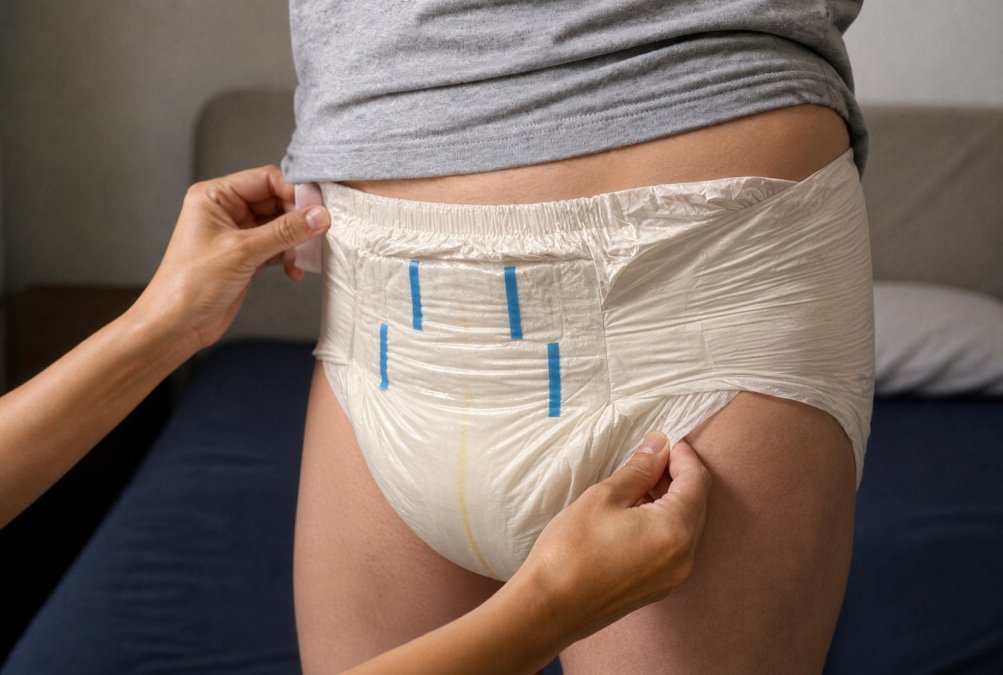
The leg cuffs are where most people fail. If the ruffles are tucked inward, urine wicks straight past the moisture barrier and onto clothing. Flip them out every single time.
Overnight Incontinence Management: Preventing Nighttime Leaks
Overnight incontinence management requires a different setup than daytime wear. You are lying down for six to ten hours, and gravity moves liquid toward the back and sides of the brief. A diaper that works all day can fail at night for this reason alone.
Start with a maximum-absorbency brief rated for extended wear. Change right before bed, and make sure the back panel sits high enough to catch liquid that travels while you sleep. For side sleepers, position the brief so the absorbent core is centered, not shifted forward.
Clothing Interference and Positioning for Side Sleepers
Tight pajama waistbands and fitted sheets create compression against a saturated core, forcing moisture out through the leg openings. This is a leak cause most guides ignore entirely. Loose-fitting sleepwear and a waterproof mattress protector remove two common failure points.
Side sleepers should consider adding a booster pad toward the back of the brief, where liquid pools. If you wake up with wetness along the hip, the brief is being compressed by your sleeping position, not failing on its own.
Troubleshooting Leaks: Signs of Poor Fit and Quick Fixes
Troubleshooting leaks starts with identifying the pattern. Where the leak appears tells you what went wrong, and the fix depends on your body type, not just the leak location.
Leak Location |
Likely Cause |
Fix |
|---|---|---|
Along the legs |
Cuffs folded inward or gaps |
Flip ruffles out, refasten bottom tabs |
Waistband front |
Brief too loose or tabs slipped |
Size down or reposition tabs |
Back or sides |
Compression during sleep |
Looser sleepwear, booster pad |
Anywhere after hours |
Overcapacity |
Step up absorbency level |
Body-Type Fit Guide: Chunky Thighs vs. Slim Waist
Generic sizing advice assumes an average build, but two body types account for most stubborn leaks, and each needs a different adjustment.
Fuller thighs, narrower waist. The waistband feels loose while the leg openings are already snug. Sizing down to fix the waist pinches the thighs and forces the cuffs to roll inward. Instead, keep the current size and use the side tabs to take in the waist, then run a finger along each leg cuff to confirm the ruffle sits flat against the thigh. If the leg opening still gaps, a brief with a taller, more elastic leg gather handles fuller thighs better than a flat-cut brief.
Slimmer thighs, wider waist or hips. The waist fits but the leg openings stay loose no matter how you fasten the tabs. This is the classic gap leak. Fasten the bottom tabs first and angle them slightly upward to pull the leg openings snug before securing the top tabs. If the legs still gap, the brief is cut too wide for your frame, a smaller size with a longer tab reach often seals better than a larger size with loose legs.
Between sizes. Size up rather than down, then use the tabs to tighten. A slightly larger brief can be adjusted; a too-small brief will always gap at the legs.
Clothing Interference: The Compression Leak Nobody Warns You About
Tight clothing does not just feel uncomfortable, it physically wrings moisture out of a saturated core. This is a leak cause most guides ignore entirely, and it is one of the easiest to fix.
- Too tight onesies, bodysuits, or control-top garments press the core against the body and force fluid out through the leg openings. Switch to looser-fitting layers over the brief.
- Fitted sheets and tucked-in bedding create the same compression overnight. A waterproof mattress protector plus a looser top sheet removes the pressure point.
- Seat belts and prolonged sitting squeeze the core against the chair. On long drives, shift position periodically and choose a SAP-forward brief that resists re-wetting under pressure.
- Layered diapers are the worst offender. Stacking a second brief traps moisture, doubles the compression, and increases rash risk.
Signs of poor fit include red marks on the skin, a waistband that slides down, and leg cuffs that will not stay flat. Red marks and skin irritation are not just comfort issues; prolonged moisture against the skin can compromise skin integrity and lead to diaper rash. If you notice recurring irritation, check your fit before assuming you need a different product.
For maximum protection, Bumz offers guidance on incontinence product selection from the Cleveland Clinic that aligns with matching absorbency to your specific needs. The right brief, fitted correctly, handles most leaks without any extra steps.
Frequently Asked Questions
Why do adult diapers leak even when they seem to fit?
Leaks often happen because of small gaps at the leg cuffs or waistband, not overall size. If the leg cuffs are folded inward or the side tabs are too loose, urine can escape before the core absorbs it. Compression from tight clothing can also squeeze liquid out. Check that the cuffs face outward, the tabs are snug, and the diaper is not bunched under pants.
How can I tell if my diaper is the wrong size?
Look for red marks on your skin, gaps at the legs, or leaks within an hour of changing. If the waistband leaves deep indentations or the diaper slides down, it is too small. If you can pull it off without unfastening the tabs, it is too large. Bumz offers sizes from Small (22"-34") to Extra Large (46"-60") so you can match your waist measurement accurately.
What are the best practices for preventing overnight leaks?
Use a high-capacity diaper like Bumz Maximum Absorbency, which holds up to 11,000mL. Change right before bed, make sure the leg cuffs are outward, and avoid tight pajamas that compress the core. If you sleep on your side, add a booster pad or choose a diaper with a wider absorbent zone. A wetness indicator helps you know if the diaper is near capacity before morning.
How often should an adult diaper be changed to prevent leakage?
Change every 4 to 6 hours during the day, or sooner if the wetness indicator changes color. Overnight, one high-capacity diaper can last 8 to 10 hours for many people. If you leak before that window, your absorbency level may be too low or the fit needs adjustment. Always clean and dry the skin before putting on a new diaper to protect skin integrity. Bumz diapers are designed to hold an immense amount (the highest capacity on the market). You should be able to easily go 8-10 hours without changing.